
Last updated October 16, 2026
 Wrought iron
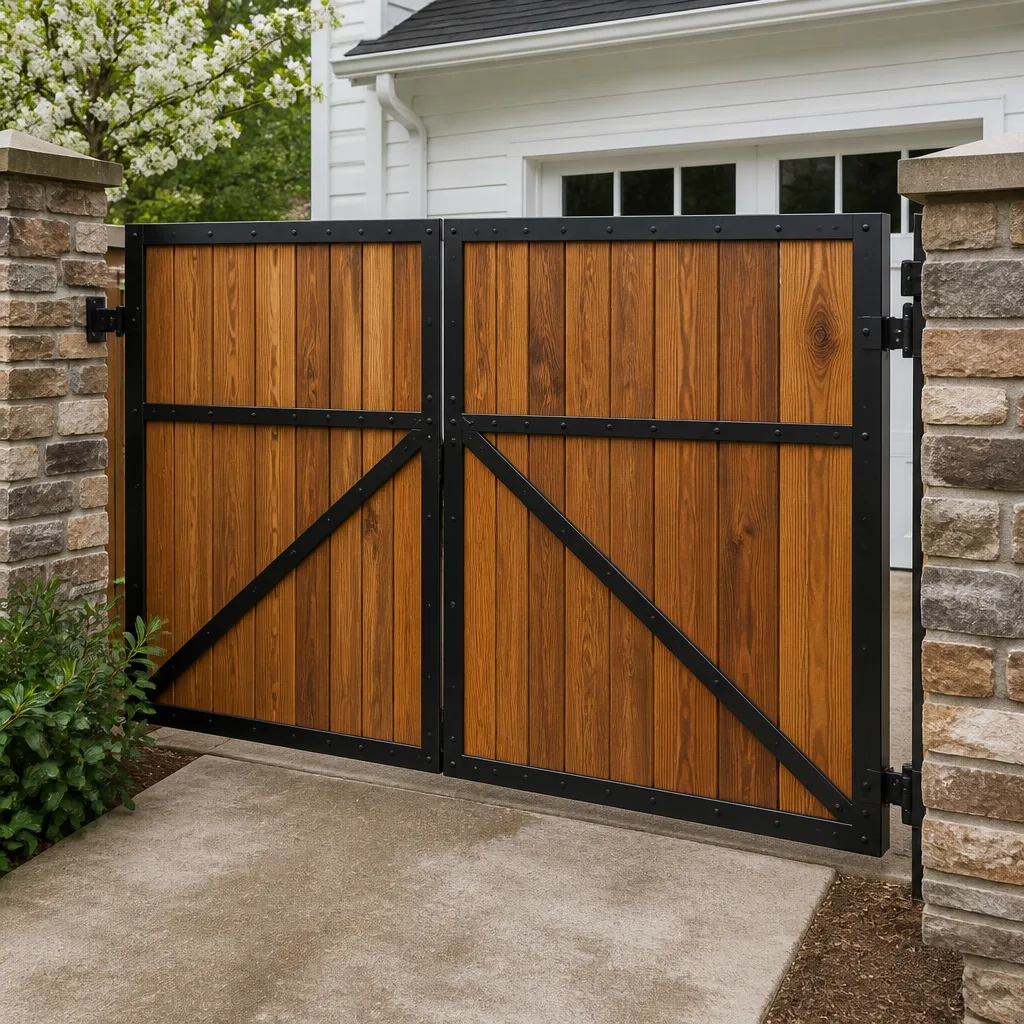 Wood & steel frame
 Farm & ranch
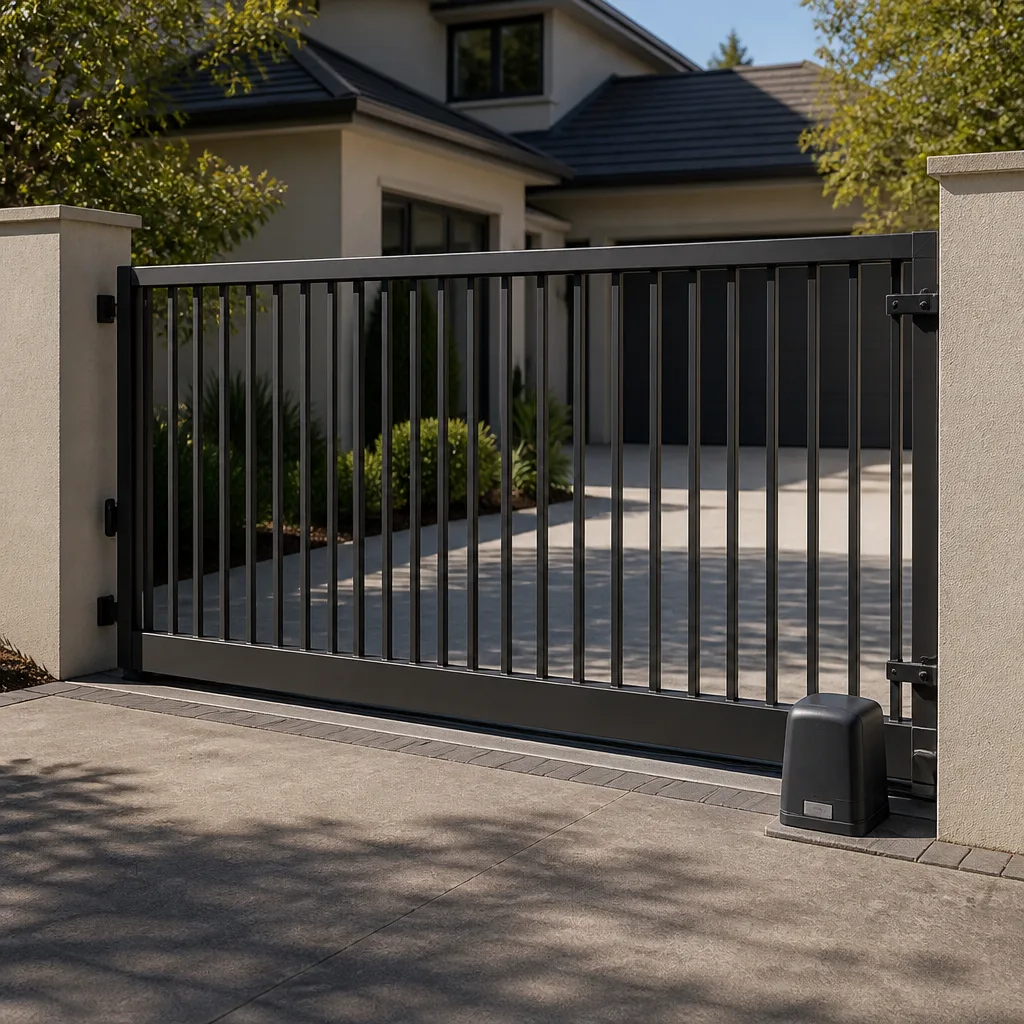 Sliding driveway gates
 LiftMaster operators
Free on-site gate assessment - hinges, posts, and your LiftMaster or Nice gate operator checked before anything is quoted
The assessment is free and the quote is the invoice.
Get your free estimateGate Repair Maintenance Checklist for Hempstead Homeowners
Most printed gate checklists are written by marketers. They tell you to “check hinges” and “inspect the motor” without telling you what a failing hinge looks like, what a healthy motor sounds like, or when a minor adjustment prevents a $900 emergency call. This one is different. It is built around the ten failure points that generate the most emergency service calls on Long Island, and it gives you pass/fail criteria for every component. By the time you finish reading, you will know which measurements matter, which readings signal trouble, and what to document so a technician spends fifteen minutes diagnosing instead of two hours guessing. For Carver Gate Repair Hempstead home maintenance guidance, this is our complete field manual.
Quick Answer
A proper gate maintenance checklist for Hempstead homeowners covers ten specific inspection points: hinge torque, gate travel speed, stop accuracy, battery backup function, chain or rack lubrication, limit switch condition, sensor alignment, track cleanliness (for slide gates), operator mounting bolts, and weather seal integrity. Each item has a pass/fail threshold described below, not a vague “check if okay.” Homeowners who follow this list and log their findings will catch most failures six to eighteen months before they become emergency calls.
Styles & brands we work with
Table of Contents
- Hinge Torque and Alignment: What “Loose” Actually Looks Like
- Gate Travel Speed and Stop Accuracy: The No-Tools Test
- Battery Backup: The Load Test Most Homeowners Skip
- Lubrication Intervals by Component: Products, Not Guesswork
- Limit Switches and Safety Edges: The Stops You Never See
- Slide Gate Track and Roller Inspection
- How to Log Findings So a Technician Can Skip the Guesswork
- Hempstead Seasonal Timing: When to Run Each Check
Hinge Torque and Alignment: What “Loose” Actually Looks Like
Hinge failure does not announce itself. A gate will sag a quarter inch, then a half inch, then one day the bottom corner drags across the driveway and the operator strains against the added load until the motor burns out. By the time a homeowner notices, the repair has already become more expensive than the adjustment would have been.
Here is the pass/fail standard we use on service calls across Hempstead. Stand at the latch side of the gate and push laterally, away from the post, with about twenty pounds of force. A healthy gate moves no more than one eighth of an inch. If you can feel movement at the hinge barrel, if you see the gate leaf shift relative to the post, or if the gap between the gate and post changes as the gate swings, that is a fail. The hinge needs tightening or bushing replacement.
For swing gates, check the hinge bolts with a wrench, not your fingers. A bolt that turns under hand pressure has already lost clamp load. For ornamental steel gates in Hempstead’s older neighborhoods, pay close attention to the top hinge. It carries the most leverage and fails first on heavy double gates. For vinyl gates, look for hairline cracks radiating from the hinge plate. Vinyl does not bend like steel; it fractures.
Alignment matters just as much as tightness. Close the gate and sight down the top rail. A gate that is square shows an even gap along the entire latch line. A gate that is sagging shows a wider gap at the top, narrowing at the bottom. If the gap differential exceeds three eighths of an inch on a six-foot gate, you have a structural issue, not a lubrication issue. Do not keep lubricating a sagging gate and hoping it levels out. It will not.
Gate Travel Speed and Stop Accuracy: The No-Tools Test
Gate operators are set at the factory to open and close within a specific speed range. When that speed changes, it tells you something about the system. A gate that opens noticeably slower than it did six months ago is usually fighting friction, voltage drop, or a degraded capacitor. A gate that opens faster than it used to can indicate a weakened spring or a motor running without proper load sensing.
Here is the no-tools test that works on any gate, in any Hempstead neighborhood, from East Meadow to Uniondale to West Hempstead. Open the gate fully and time it with the stopwatch on your phone. Wait thirty seconds. Close it and time that cycle too. Write both times down. Do this monthly. A change of more than 25 percent from your logged baseline, in either direction, is a fail. It means something in the system has changed.
Stop accuracy is the second half of the test. The gate should stop in the same place every time, within half an inch. Watch the gate close. Does it bounce back? Does it slam into the closed stop and recoil? Does it stop two inches short of where it stopped last week? Any of those behaviors means the limit settings, the force settings, or the physical stops have shifted. On BFT and Viking operators, which we service regularly, this often traces to a limit switch that has accumulated grit. On Linear and Ghost Controls equipment, speed drift usually points to a capacitor or a board issue. The point is not to diagnose the cause yourself. It is to know that drift from baseline is never normal. Log it and call.
Battery Backup: The Load Test Most Homeowners Skip
Most homeowners test a battery backup by unplugging the operator and opening the gate once. That only proves the battery has enough surface charge to move the gate a few feet under no real load. It does not prove the battery can move the gate through a full cycle after three days without AC power, which is what a backup battery is actually for.
The load test takes fifteen minutes and tells you the truth. Here is the procedure. First, unplug the operator from AC power. If it is a solar system, cover the panel or disconnect the charge controller input. Second, cycle the gate open and closed five times in a row, waiting thirty seconds between cycles. Third, measure the cycle time on the fifth cycle. If that fifth cycle is slower than the first by more than 15 percent, the battery has degraded. Fourth, leave the gate unplugged (or the panel covered) for four hours. Then run one more cycle. If the gate strains, creeps, or fails to complete the cycle, the battery is end-of-life.
For Hempstead homeowners, this test matters more than it does inland. Coastal humidity and salt air corrode battery terminals faster, and the freeze-thaw cycles we get every winter shorten lead-acid battery life. We see batteries that test fine in September fail completely by February. Run the load test every fall, before the first freeze, and every spring. Write down the fifth-cycle time in your log. That number is the earliest warning you will ever get.
Lubrication Intervals by Component: Products, Not Guesswork
“Use grease” is not a lubrication spec. Different components need different products on different schedules, and using the wrong product shortens component life. Here is the schedule we recommend for gates in the Hempstead area, where salt, humidity, and temperature swings punish everything exposed.
Chain drives: Lubricate every six months with a dry film lubricant or a motorcycle chain lube designed for O-ring chains. Do not use heavy axle grease. It collects grit and turns into grinding paste. Apply to the chain while the gate is stationary, then run the gate through two full cycles to work the lubricant into the links.
Rack and pinion (slide gates): Every four months, clean the rack teeth with a wire brush or compressed air, then apply a thin coat of open-gear spray lubricant. A rack that looks dry and shows metal dust is already wearing. A rack coated in caked-on grease is holding abrasives against the teeth. Neither is pass.
Gate hinges: Every six months, apply a few drops of machine oil or spray white lithium grease to each hinge barrel. Wipe away excess. In Hempstead’s winter, hinges that go all season without lubrication get stiff, and stiff hinges make the operator work harder. That extra load is what kills motors early.
Limit switch mechanisms: Every six months, clean the switch housing with dry compressed air. Do not lubricate limit switches. Oil attracts dust, and dust is what causes limit switches to misread position. If a limit switch is sticky after cleaning, replace it.
Articulating arm and swing operator joints: Every four months, grease the pivot points on the arm itself. Use a lithium complex grease with a temperature rating that covers below-freezing operation. A dry articulating arm binds, and a binding arm pushes the operator out of alignment.
The interval matters less than the consistency. A gate lubricated on schedule, logged each time, will outlast a gate lubricated sporadically with whatever is on the shelf. Write every lubrication date in your log. Your future technician reads it and knows what has been maintained and what has been neglected.
Limit Switches and Safety Edges: The Stops You Never See
Limit switches are the mechanical or magnetic sensors that tell the operator “the gate is open, stop now” and “the gate is closed, stop now.” When they fail, the gate either stops short, over-travels, or slams against the physical stops until the motor overheats. They fail slowly, and the first symptom is usually a gate that closes fine but stops three inches short on opening, or vice versa.
Testing limit switches is visual and auditory. Run the gate open. Listen for a clean stop, not a strained stop. If you hear the motor laboring for a split second before it cuts out, the gate is pushing against its physical stop because the limit switch did not cut power in time. That hesitation is the audible warning. Next, run the gate closed and watch the closed position. If it varies by more than half an inch from one cycle to the next, the limit switch is drifting. On a gate that reverses or bounces at the closed position, the limit switch has failed entirely and the safety edge is acting as the stop, which is not what it is for.
Safety edges are the pressure-sensitive strips on the leading edge of the gate and, on some installations, on the gate frame. Test them by closing the gate and pressing firmly on the edge with a gloved hand. The gate should stop and reverse immediately. If it does not, or if the reversing action is delayed by more than a second, the edge or its controller has a problem. Here is the local reality for Hempstead: we regularly see safety edges that have been exposed to years of direct sun and winter salt develop cracks in the rubber casing. Water gets in, the internal switch corrodes, and the whole strip needs replacement.
Slide Gate Track and Roller Inspection
Slide gates on Long Island live in a hostile environment. Road salt, sand, and leaf debris collect in the track, and the rollers grind that material into the wheels and bearings. A slide gate that rolls smoothly in July can bind in January, and the operator, which is sized for a certain rolling load, cannot tell the difference between a stuck gate and a heavy gate. It just works harder until something fails.
The track inspection is a monthly job during leaf season and after winter storms. First, remove every piece of debris from the track. Twigs, leaves, plastic, ice. All of it. Second, look at the track surface. It should be clean metal or clean concrete, depending on your installation. Stains are fine. Gouges, rust scale, or grooves worn into the track are not. Third, inspect the carrier rollers. Spin each one by hand if you can access them. They should spin freely, with no grinding and no lateral wobble. A wobbling roller carves grooves into the track and wears itself out fast.
One note for Hempstead homes with welded steel slide gates: the corrosion pattern here tends to attack welds first, especially on the lower frame members that sit closest to the ground and trap salt water. Run your fingers along those lower welds every fall. If the paint has lifted, chipped, or shows rust staining, touch it up before winter. A gate that loses a lower cross-member to rust can pull itself out of square and drag on the track in a single season.
How to Log Findings So a Technician Can Skip the Guesswork
The maintenance log is the single most underrated tool in gate ownership. When a technician arrives at a gate that has failed, the first hour is usually spent figuring out what the gate was doing before it stopped. A log answers that in thirty seconds. We ask every customer on a service call what the gate has been doing. Homeowners who keep a log hand us a notebook, and we start the repair already knowing which direction to look.
The log does not need to be anything elaborate. A spiral notebook in the garage works. A notes app on a phone works. What matters is that each entry has five things: the date, the mileage-equivalent (how many cycles per day the gate runs, roughly), the component inspected, the measurement taken, and whether it passed or failed. Here is an example entry:
November 12 | Gate runs ~14 cycles/day | Hinge push test | Pass: no movement at hinge barrel | Pass
November 12 | Gate runs ~14 cycles/day | Battery load test, fifth cycle time | 6.2 sec vs baseline 5.4 sec | Pass
March 3 | Gate runs ~14 cycles/day | Slide gate track | Gouge found 8 in from closed stop | Fail
The entries do not need to be long. They need to be consistent. A technician reading twelve months of entries can see a trend: travel time increasing, fifth-cycle battery time stretching, hinge movement growing. That trend is more valuable than any single reading. It tells us the system is degrading before it fails, and we can schedule a service call at your convenience instead of showing up at midnight during a snowstorm because the gate will not close.
Hempstead Seasonal Timing: When to Run Each Check
Hempstead’s climate does not allow a once-a-year maintenance schedule. The freeze-thaw cycles from December through March, the salt on the roads and driveways, the humidity from May through September, and the heavy leaf drop in October and November each stress different components. Here is the seasonal rhythm we recommend.
Spring (April): Full inspection. Run the complete checklist: hinge push test, travel speed timing, battery load test, limit switch observation, safety edge test, track cleaning, and lubrication of all moving parts. Spring is when you find the damage winter did. Salt corrosion on terminals, stiff hinges from months without lubrication, and battery degradation from cold soak all show up now.
Summer (July): Speed and heat check. In Hempstead’s summer heat, gate operators run hot, and hot motors draw more current. Time the travel speed and compare to your spring baseline. Check the operator housing for obstructed vents or clogged cooling fins. If the operator feels abnormally hot to the touch after a cycle, note it. That is an early warning of a motor working too hard.
Fall (October): Battery load test and leaf cleanup. This is the critical battery test, run before the first freeze. A battery that fails the load test in October can be replaced before it strands you in January. Clean the track weekly through October and November. Hempstead’s leaf drop is heavy, and a slide gate track full of wet leaves freezes into a solid block in a cold snap.
Winter (January): Post-freeze check. After the first hard freeze, run a full open-close cycle and watch for binding. Test the safety edges. Check the hinges for stiffness. Keep the track clear of ice and snow. Do not chip ice off the track with a hammer; use a plastic scraper or de-icing product designed for concrete and steel. Chipping with metal tools scores the track surface and creates rust points.
Common Mistakes to Avoid
- Lubricating without cleaning first. Applying fresh lubricant over old, gritty grease buries the abrasive particles deeper into the component. Clean the surface, then lubricate. Skipping the cleaning step is worse than skipping the lubrication.
- Ignoring a slow drift in gate speed. A gate that takes an extra second to close is not “just getting old.” It is working harder. That extra load is burning motor life. Time the gate monthly and act on any change over 25 percent.
- Testing the battery backup by unplugging the gate for one cycle. That is a surface charge test, not a load test. Follow the five-cycle procedure described above. A battery that passes the one-cycle test can still be dead after four hours of outage.
- Greasing the limit switches. Limit switches fail from contamination, and grease is contamination. Keep them dry and clean. If a limit switch is sticking, replace it. Grease makes it worse.
- Chipping ice off a slide gate track with a metal tool. Every gouge you put in that track becomes a rust seed. Use plastic tools and calcium chloride de-icer, then clean the track thoroughly in the spring.
- Adjusting the force settings on the operator as a fix for a binding gate. When a gate starts camming over or dragging, some homeowners turn up the force dial so the gate “pushes through.” That is a temporary patch. The operator is now fighting a mechanical problem with more power, and the next failure is more expensive than the first one would have been.
- Not keeping any written record. The technician who arrives in the middle of an emergency does not know what your gate did last summer. A simple notebook with the dates, times, and pass/fail results saves paid diagnostic time and makes every future repair more accurate.
See the difference
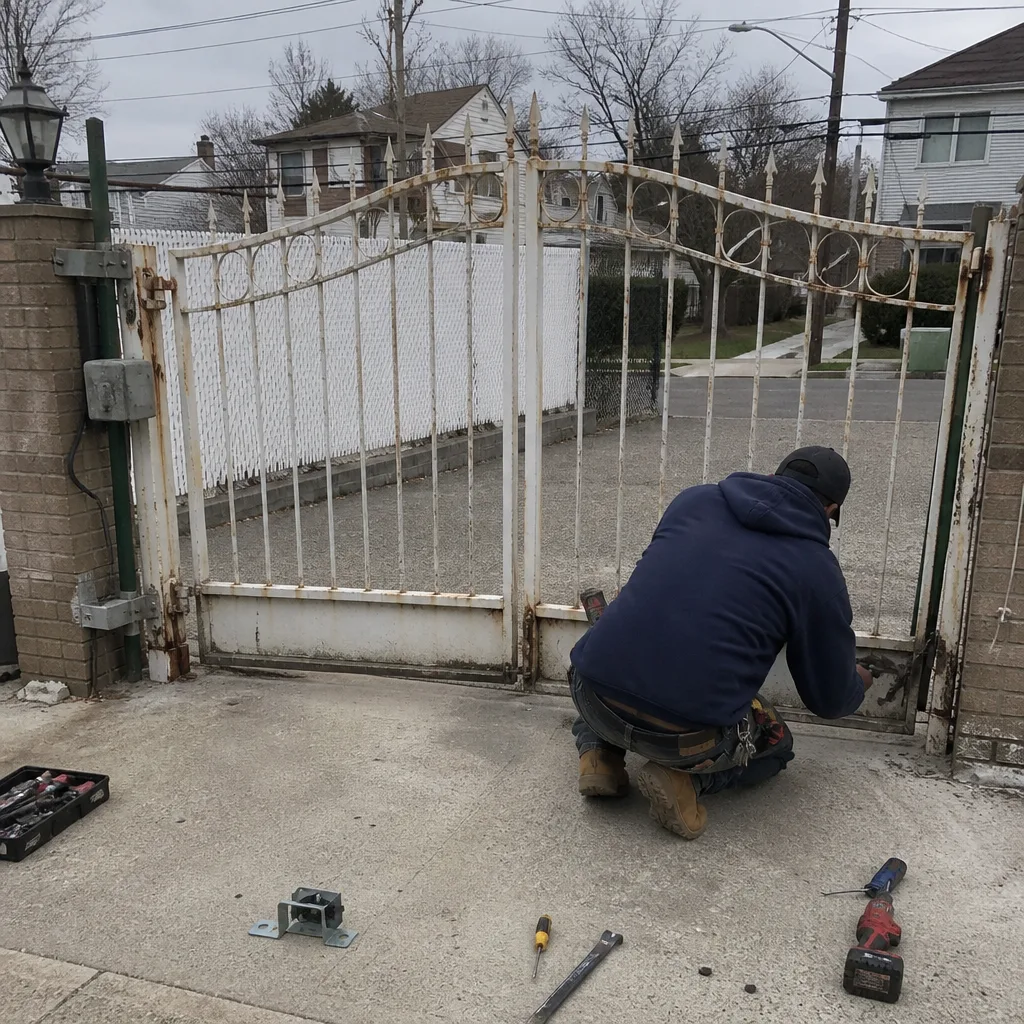 Before
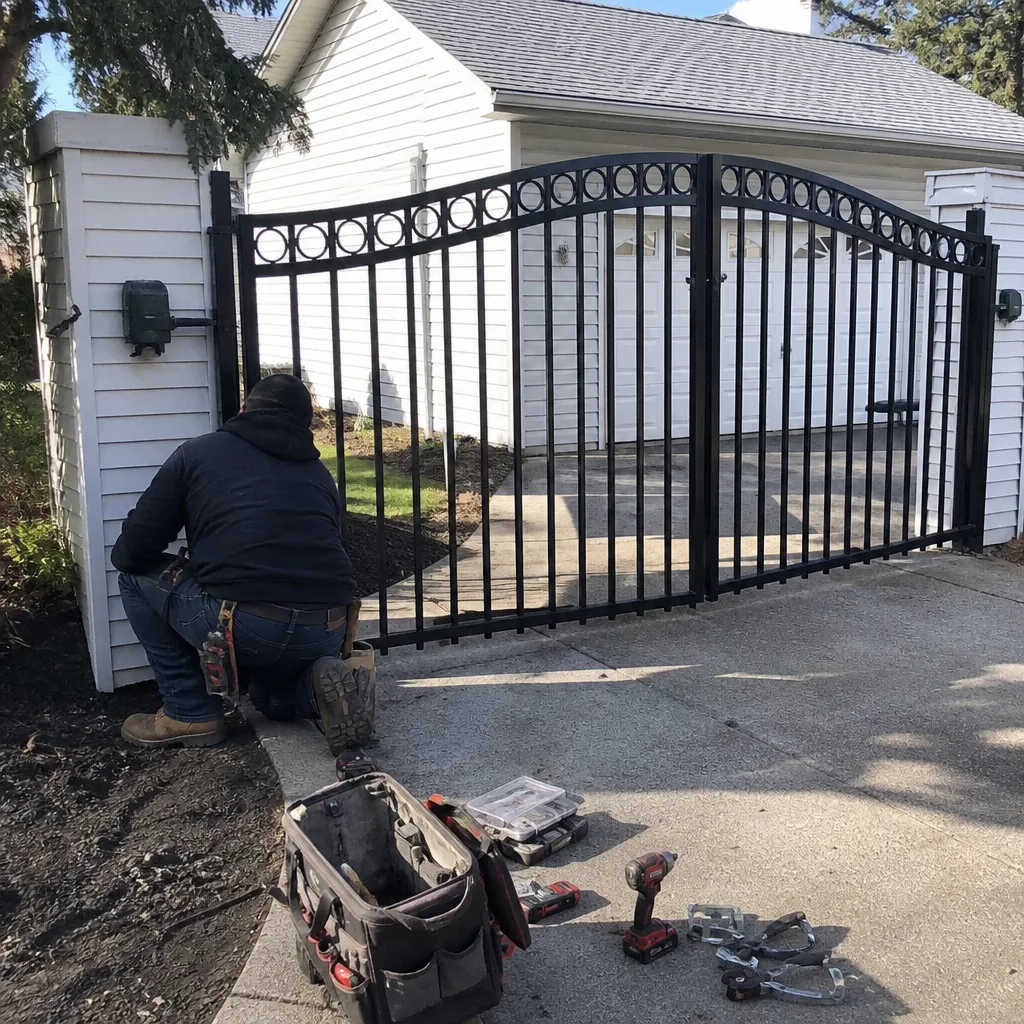 After
After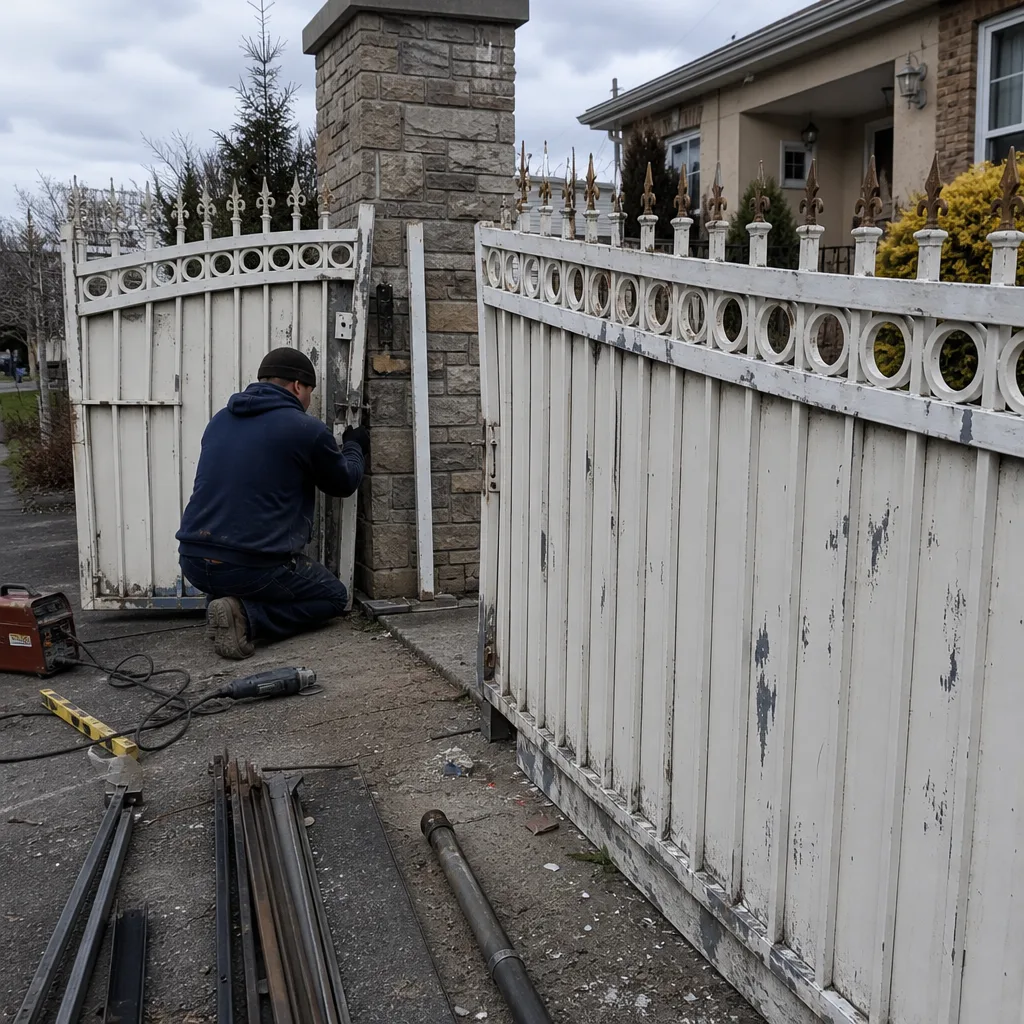 Before
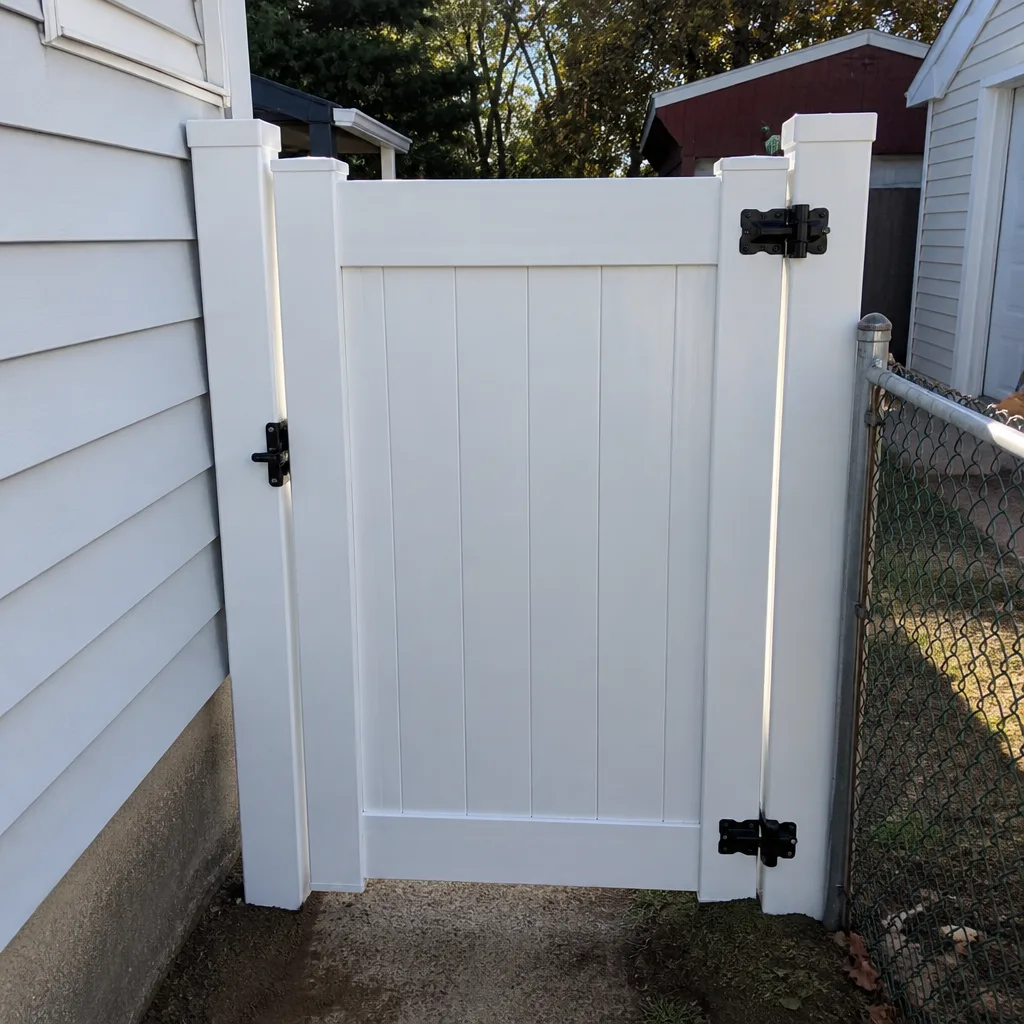 After
After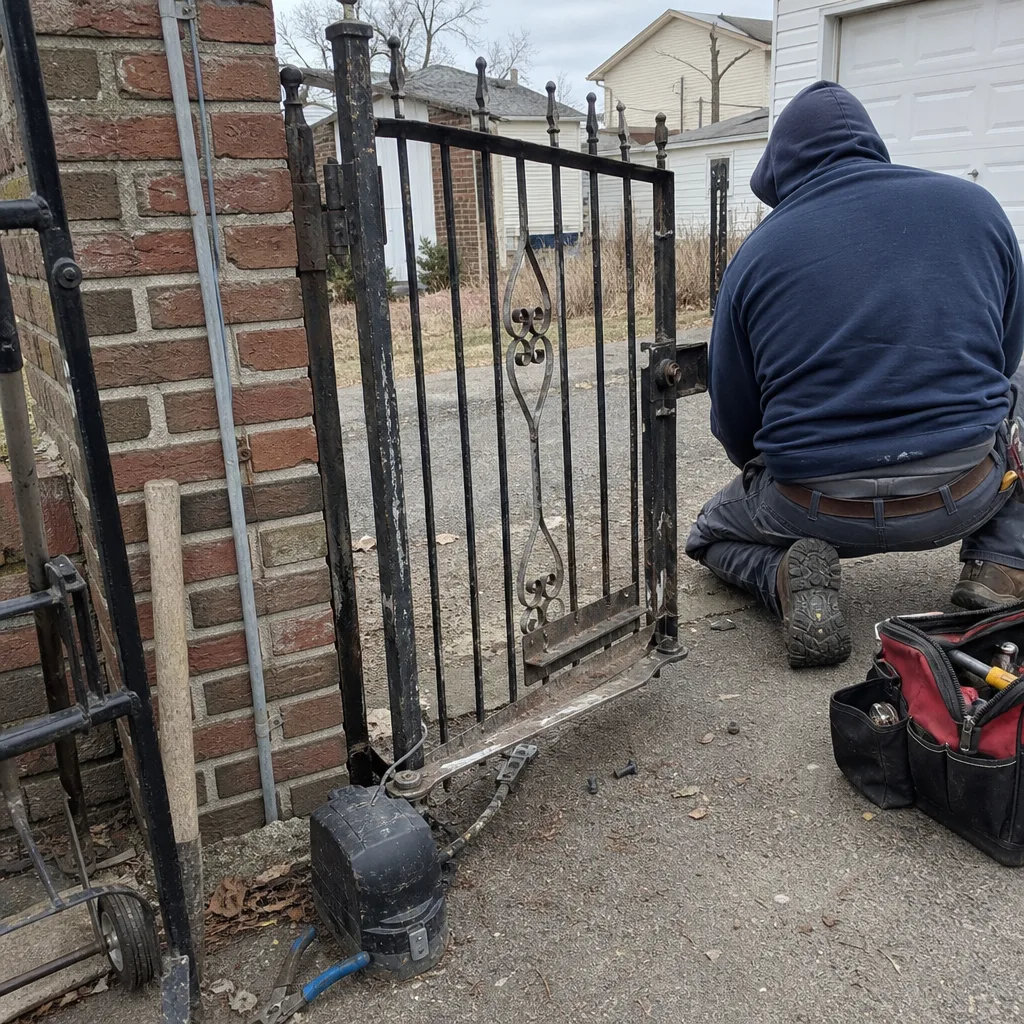 Before
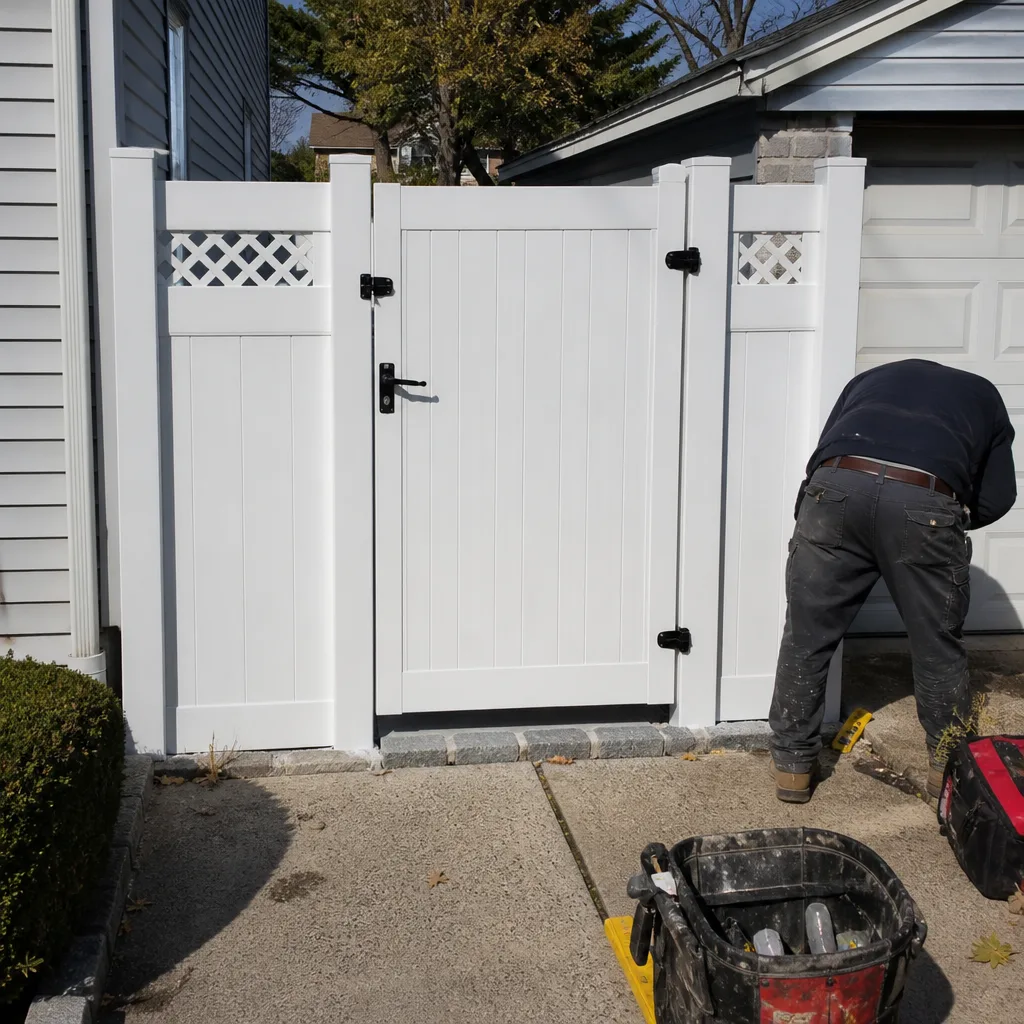 After
AfterWhen to Call a Professional
Some findings on this checklist are minor and can wait for your next scheduled maintenance. Others are not. Call a professional the same day if the gate will not stay closed or will not stay open, if you hear grinding or popping from the operator housing, if the gate reverses on its own for no reason, if a safety edge fails the stop-and-reverse test, or if a hinge is visibly separating from the gate frame. Also call if you see a weld that has cracked on any structural member. A cracked weld in Hempstead winter turns into a snapped frame member in a matter of weeks. Gate Repair in Hempstead covers these failures, and Gate Motor Repair in Hempstead covers the operator side when the failure is inside the motor. For new installations, Gate Installation in Hempstead is the starting point. Carver Gate Repair Hempstead offers free estimates in Hempstead – call (516) 559-4870.
Frequently Asked Questions
Run a basic visual check every month and the full ten-point checklist every spring and fall. The battery load test is seasonal, and slide gate tracks need weekly cleaning during leaf season from October through November.
The most common failure we see is a burned motor caused by a binding gate that was ignored. The hinge, track, or roller binds, the operator fights the load, and the motor overheats. The mechanical problem usually shows up months before the electrical failure. This checklist catches that mechanical problem early.
If you do the inspection and lubrication yourself, the annual cost is under $80 in materials – lubricants, a wire brush, a notebook. A professional maintenance visit in Hempstead typically runs between $150 and $350 depending on the gate type and what is found. A motor replacement runs multiples of that. The maintenance is always cheaper than Gate Repair after a failure. Call (516) 559-4870 for a written price before any work begins.
Yes. The procedures in this guide are written for homeowners. What a homeowner should not do is open the operator housing, adjust limit switch settings, or increase force settings. Those adjustments require training, and getting them wrong creates safety issues.
They do, but the damage is usually to the battery and the mechanical components, not the motor itself. Salt corrosion attacks battery terminals and hinge surfaces. Freeze-thaw cycles stress welds and track surfaces. The operator fails because it is forced to work against these degraded components, not because the cold directly damages the circuit board.
Yes. Our technicians are trained on BFT, Viking, Ghost Controls, Linear, and the other major brands, and we carry parts for all of them. Call (516) 559-4870 and a live person answers, day or night, or browse more guides & resources online.
The Bottom Line
A gate maintenance checklist is only as good as its pass/fail thresholds. This one gives you specific measurements: one eighth of an inch of lateral hinge movement, 25 percent drift from baseline travel time, 15 percent speed loss on a fifth-cycle battery test, a three-eighths-inch alignment differential on a six-foot gate. Run the checks on the seasonal schedule that fits Hempstead’s climate, write down the results, and call a professional when a measurement fails. The ten failure points covered in this guide are the same ones we see generating emergency calls across Nassau County. Catch them early and a gate runs for decades. Let them slide and every one of them eventually becomes an expensive failure.
Written by Lonnie Burke, Owner at Carver Gate Repair Hempstead, serving Hempstead since 2008.